AI 2026
Read blogPart 1: Chips
This is Part I in a three-part series looking at Chips, Models, and Agents.
Today is Day 1 of the singularity.
What company is powering it? Nvidia.
Nvidia, who shakes the Earth.
Nvidia, who came before all.
Nvidia, the Chipmaker.
Nvidia, birthed by Jensen, a man among boys.

In this piece, I’ll show:
- How Nvidia built 10 GW of AI compute
- The coming 100 GW wave
- Four competitors attacking this 100 GW opportunity
Let’s do it.
1. The 10 GW Opening
We build more data centers than offices.
Data center vs. office construction
These complexes are massive.
Stargate
Nvidia is at the center of the data center buildout.
Total chip capacity has 10x’ed from 2M H100e to over 20M H100e.
AI chip sales
This has increased their revenue from $100B to $300B a year.
Nvidia is making over 50% of all company revenues from GenAI.
Annualized GenAI revenue
Plus, they’re doing so with never-before-seen operating margins.
They have 66% operating margins compared to 33% for Big Tech.
Operating margin
And an annualized profit of $250B compared to $125B for Big Tech.
Annualized operating profit
This is even more impressive when you compare it to previous eras.
IBM, Wintel, and Big Tech had around 25% margin.
Nvidia has averaged 56%.
Profit & Margins Across Tech Eras
Nvidia is a really good business.
They’ve become the most valuable company in the world.
Now everyone else wants part of the GPU pie.
Nvidia’s margin is the rest of the industry’s opportunity.
NVIDIA market cap

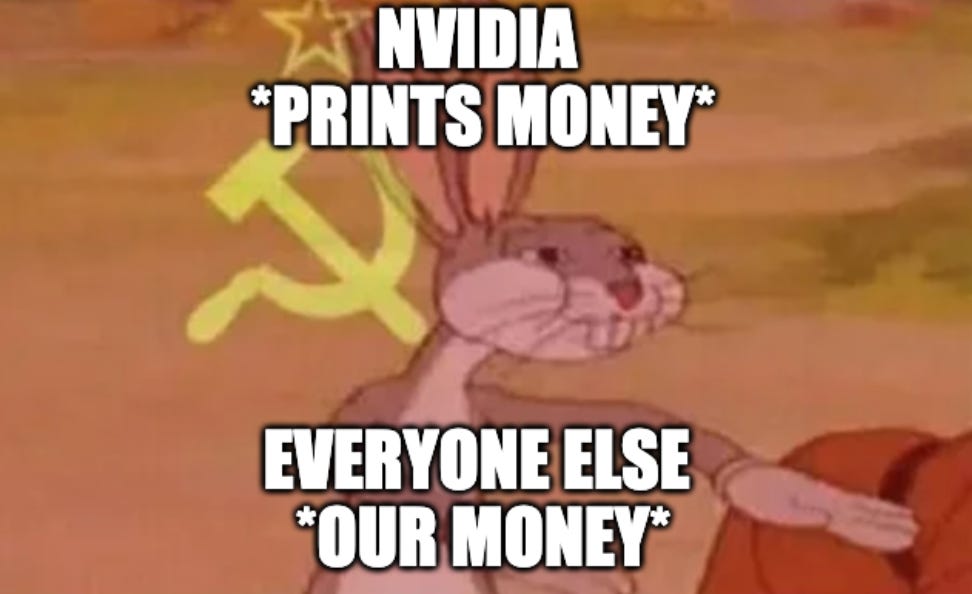
NVIDIA
*PRINTS MONEY*
EVERYONE ELSE
*OUR MONEY*
2. The 100 GW Wave
…So what’s the actual opportunity here? Has Nvidia already eaten all the profits?
Likely not.
From 2020 to 2025, we built 12 GW of data center capacity.
Nvidia GPUs filled 70% of them.
But we’re likely to 10x to 100 GW by 2040.
...It’s easy to add a bar to a chart.
Capacity added since 2020
It’s hard to actually build a gigawatt.
A gigawatt is massive.
It has giga in the name.
It takes one minute and 42 seconds to drive past a data center at 70 mph.
A GW data center could power a million US homes.
The electricity for a whole city.

It’s tough to know how many data centers will actually get built.
Epoch estimates 100 GW by 2030, not 2040.
But their data center permit database only shows 32 GW by 2028.
Part of this is a permitting issue.
By 2028, a16z estimates 44 GW new planned, 25 GW permitted, 19 GW shortfall.
Capacity added since 2020
Part of this is an electricity issue.
The US is at 1 TW trying to get to 2 TW. While China is at 4 TW, planning to get to 8 TW.
Electricity
In any scenario, expect 100 GW of data centers soon, mostly in the US and China.
All of these data centers will need GPUs.
3. 100 GW, Four Competitors
Averaged through 2040, each GW will power $20B of chips.
So the 100 GW opportunity is also a $2T opportunity.
The chip opportunity
Four types of companies are trying to take Nvidia’s margin:
1. Hyperscalers like Amazon Trainium and Google TPUs are competing on training.
Trainium is Amazon's chip. The Trainium 3 might become the Amazon Basics of GPUs. Anthropic recently committed to 5 GW of compute through Amazon. 2M will be Nvidia GPUs, but many will be Trainium chips.
Google seems to be focusing more on GCP. They’re expanding their TPU lineup into training (8t) vs. inference (8i).
2. Startups like Cerebras, Etched, and SambaNova are competing on inference.
Cerebras is going to add 750MW of ultra-low latency chips to power ChatGPT’s new Ultrafast mode. On Ultrafast, Sol 5.6 answered 2,500 HLE questions in 11 hours vs. Claude Fable 5 in 78 hours. In other words, “Ultrafast worked through the frontier of human knowledge in a single working day.” (!!!)
Etched is building frontier inference clusters that break up then optimize pre-fill and decode.
Pre-fill is compute-constrained, so they’re compute maxxing by voltage minimizing (LVI). Decode is memory-constrained, so they’re building Cluster Scale Memory with a better NVLink, which allows larger clusters to decode at once.
As their founders said recently on Invest Like The Best, it’s crazy that training clusters like Colossus are 100,000 chips networked together, while inference clusters are still just eight chips.
3. Model providers like OpenAI are competing on decode.
OAI released Jalapeño’s first results at the end of August.
And damn, it’s impressive. It’s Pareto-dominant against GB200 NVL72:
How did OpenAI do this?
Step 1: Buy 40% of all DRAM. Step 2: used Codex for chip design (1, 2). Step 3: Optimize for LLMs specifically, not GPUs generally. It’s a decode-first, watt-minimizing chip, optimized for efficiently streaming 1 TB of model weights out of HBM.
4. Chinese chipmakers like Huawei are starting to catch up.
GLM 5.3 was served entirely on Chinese hardware:
having a frontier model served at scale on purely Chinese hardware is new territory . https://t.co/N85bqhQkRv
— Sriram Krishnan (@sriramk) August 26, 2026
Huawei just announced their LogicFolding process, which plays 3D chess and should reach 1.4nm by 2031. This is only 3 years behind TSMC.
China is trying to rebuild its chip stack domestically.
- SMEE is 20 years behind ASML (90nm vs 2nm).
- SMIC is 6 years behind TSMC (7nm vs 2nm).
- Huawei is 3 years behind Nvidia (910C vs H100).
- CMXT is 3+ years behind SHM (HBM3 pilot vs. HBM4 production).
Since 2010, Chinese companies have been catching up.
Conclusion
However you slice it, this is a massive market.
There’s 100 GW of chips to build and $2T of chips to sell (2% of global GDP!). Nvidia will be trying their darnest to keep 70% market share. (Including financing $500B of chips, with the chips themselves as collateral.)
I think I’ve captured the highest-order bit relatively well (100 GW, $2T). But there’s so much I didn’t cover:
- Besides energy, what else might constrain chip production? ASML EUVs, TSMC CoWoS, HBM supply. (Rough take: never underestimate the elasticity of supply.)
- Is AI a bubble? Maybe, yes, no, always.
- One answer starts with the question: What is the payback period for 100 GW of infrastructure? It took a few decades to pay back railroads and internet fiber. But GPUs have a short 6-year depreciation period. But but, AI revenues are already above $100B. I’ll look more deeply at some of these questions in Part 2, Models & Part 3, Agents.
- What is the fundamental axis of competition for chips? Where’s the most defensible moat? Are chips governed more by bundling and Clayton Christensen’s Law of Conservation of Modularity? Or by Ben Thompson’s Aggregation Theory? If Nvidia is Wintel for GPUs, what is the AI-native OS?
- Moving away from economics, what are the social impacts of this data center buildout? How can we ensure builders benefit local communities? What is the memetic ecology of anti-data center sentiment? How can the US stay positive-sum with China?
But idk. Those are all specifics. Zoom out. The Earth is waking up. The Digicene is coming. Today is Day 1 of the Singularity.
The Earth is waking up.

Thanks for reading. Curious for your thoughts.
- Rhys
Thanks to Casey Caruso, Jamie Daudon, Amelia Rina, Adam Segal, and Zack Sulsky for feedback on this post.
Looking for my next gig btw. Here’s how I can help. Would love to chat!
Subscribe for Part 2: